
Alabama Recent Arrests
An arrest and a booking are two separate steps. Officers take a person into custody first. Booking into the local jail comes later, and a different office may hold each record. A sheriff's roster might list people still in custody, a released booking, or only the newest few entries. A blank roster proves nothing. The county may lack a public feed. The person could have been released or transferred, or law may restrict the record.
Alabama has no single statewide booking database. Each sheriff and jail decides what appears online. Some counties run searchable vendor portals, while others post dated lists, short-window views, or nothing at all. Refresh schedules vary too. A booking photo is an identification image made during intake. What a roster shows can differ from the full record an office keeps on file.
The path from arrest to resolution runs through several offices. Arrest to court: Arrest → booking and identification → county roster if published → court case → final disposition → possible sealing or expungement.
Alabama Booking Record Fields
County and state systems answer different questions. County booking records capture intake details. The Alabama Department of Corrections (ADOC) search covers people in state custody after sentencing. No two Alabama jails use the same field set. A web roster may leave out details the full record holds. Treat the table as a list of fields to ask about, not a promise of what every county posts.
| Record field | What it can show |
|---|---|
| Name and booking number | Identity labels and the jail's record key, when supplied. |
| Arrest and booking dates | The arrest event and the later intake event, which may not share a date or time. |
| Arresting and booking agency | Who made the arrest and which office accepted the person into custody. |
| Charge as booked | The charge recorded at intake, not a court finding or final disposition. |
| Bond, status, and release | Where the system publishes them, the bond entry, custody label, or release event. |
| Photo | An identification image only if the agency's public policy and system display one. |
ADOC's official inmate search tracks state-prison custody, not recent county arrests. It can return a name and an AIS or register number. Age, race, sex, release date, and institution also appear. County-style booking photos are not promised. The locator also excludes Youthful Offender Act inmates. Someone missing there may still sit in a county jail, federal custody, or another setting.
- Booking
- The jail intake and identity process after an arrest.
- Bond
- A court-set release condition or amount, not a final outcome.
- Arraignment
- A court hearing where a person is told the filed charge and enters a plea.
- Disposition
- The final or current court result for a case.
- Expungement
- A court-ordered process that can restrict or remove eligible records under Alabama law.
Requesting Alabama Arrest Records
A public record can still take a written request. Alabama Code §36-12-40 lets citizens and residents inspect and copy public writings, subject to exceptions. Each agency sets its own form, appointment rules, delivery method, and reasonable cost. A roster is not the whole file. Incident reports, booking sheets, photos, dispatch records, and video may sit with different offices. Ask the records custodian for a fee estimate. Also ask which rule backs any redaction or denial.
Start with the county where the arrest occurred. The sheriff or jail usually keeps the booking record. The arresting police department often holds the incident report instead. For a Highway Patrol stop, ALEA may hold the trooper's report or recording. The person is generally booked at the responsible county or municipal facility. If an office lacks the record, ask it to name the right custodian.
- State the person's name, arresting county or agency, approximate date, and any incident or booking number you know.
- Name the exact record: booking sheet, arrest report, booking photo, jail log, video, or court disposition.
- Ask which form and delivery method the office requires, request an itemized cost estimate, and ask for the legal basis of any withholding.
- For time-intensive requests, follow the custodian's written process and decide whether to proceed after receiving its estimate.
Alabama's general request procedure sits in §36-12-44. It sets acknowledgment and response steps, including a longer path for time-intensive requests. No law promises the record exists, is ready at once, or comes out unedited. The Alabama records-law page covers statewide timing and limits.
Note: A written request is strongest when it names one record type, a date range, the likely custodian, and a way to identify the booking.
Alabama Mugshot Law and Removal
Alabama has no statewide private anti-pay-to-remove mugshot law. One bill, HB135, failed. A later bill, HB8, died too. So publishers face no removal mandate. What the state does have is Alabama Code §41-9-625, which governs criminal-justice biometric records. It covers fingerprints and photographs that criminal-justice agencies collect. When a person is released without charge or cleared through the proper process, the record must be reported and removed inside the state system. That is where its reach ends. No private publisher or search engine is ordered to erase a copied photo.
Alabama's highest court weighed in, too. In Mobile Press Register, Inc. v. Lackey, it held that §41-9-625 does not authorize hiding a full public court file. Alabama therefore runs two distinct record paths: a cleared arrest can be corrected within the criminal-justice system, while a court file or private copy may need a separate legal or publisher process. The statute text and the state law analysis set out those limits.
Free publisher routes still exist for a qualifying disposition. Busted Newspaper takes a request with the listing URL and legal proof. RecentlyBooked offers a no-fee correction or removal request with the record details and supporting documents. A court order or final disposition can help. No publisher's policy is Alabama law. Skip any paid erase-everything promise; fix the official record first, then ask each site holding a copy about its own free process.
An arrest photo is a booking record. Copies held by private publishers can linger even after the case ends.
Find Alabama Recent Arrests
Start with the arrest county. A statewide name search will miss most of it. County feeds share no vendor, field set, or clock. Open the Alabama County Directory and find the county's official sheriff or jail site. Look for a current roster or dated arrest report. If the county site links a vendor, use the sheriff's link to confirm the service. A city police department may hold the incident report, while the county jail holds the booking entry.
For a recent event, compare the short-window page with the main custody roster and check the posting date. Names get misspelled. A person may be held outside the county or released before the public view updated. Need an urgent custody answer? Call the jail or records unit the county lists. To track a release or transfer, use the VINELink custody service where the local jail is connected; a no-result search is not proof that no arrest occurred.
- Confirm the place and likely arresting agency, then open that county's official sheriff or jail page.
- Check the county's published short window and current roster. Read the label carefully: a 96-hour list or weekly report is not a 24-hour feed.
- Use the jail's listed records contact to confirm a just-processed booking or request a record that is no longer online.
What if the name is not there? Ask the arresting agency which jail accepted the person and whether a public entry is pending, restricted, or already removed.
Alabama County Booking Feeds
Alabama's same-day landscape varies widely. Some feeds carry true 24-hour labels. Others are short lists with wider or uncertain windows, so no example is a statewide guarantee. Each is a county system, and the published screen can change when its vendor or sheriff updates the service.
| Official view | What the label means | Use with care |
|---|---|---|
| Baldwin and Perry | Official pages provide an exact 24-hour route. | A portal can require extra access steps or show a vendor-controlled window. |
| Etowah and Talladega | “Booked Last 24 Hours” or a date-range search. | Filters can be narrower or wider than the visible default. |
| DeKalb, Jefferson, Tuscaloosa | Newest-first rosters or date controls can surface recent bookings. | A sort order is not a published refresh promise. |
| Montgomery | The recent-arrests page shows the last 96 hours. | It is useful for a short range, but it is not an exact 24-hour feed. |
| Many rural counties | Only a current roster, records contact, or no verified public feed may be available. | Ask the custodian before assuming the record is absent. |
The statewide Daily Arrest Report page compares true same-day views with county routes. The Weekly Arrest Log page covers multi-day reports and archives. A daily booking list answers one question. Who may have entered custody within its stated window?
Where Alabama Mugshots Appear
Official county pages come first. The sheriff, jail, or arresting agency created the record. Photo practice varies across Alabama. Some rosters show booking images. Other county pages and short-window wrappers promise none. A photo can be missing because the display omits it, the agency has not posted it, or the person is not in the current view. The image's source and date matter.
The image links to Busted Newspaper's Alabama section, an unofficial copy of booking-related material. The RecentlyBooked Alabama selector is another secondary source, and both sites vary in county coverage, fields, and update timing. Treat them as discovery leads only, then verify the name, booking date, charge, and status with the originating agency or court.
| Channel | What may appear | Authority | Best use |
|---|---|---|---|
| County sheriff or jail roster | Booking details and a photo where published | Official | Current or recent local booking lookup |
| Arresting police agency | Incident or arrest report, subject to limits | Official | Confirm which agency made the arrest |
| Alabama court access | Case events and disposition, not the jail record | Official | Check what happened after booking |
| Third-party indexes | Copied names, charges, or photos where available | Unofficial | Use only as a lead; verify with the source record |
A second secondary source is Mugshots.com's Alabama index. It is an independent publisher. The page shows a search interface rather than a government roster or a set of booking photos, and no unofficial page can establish current custody or a final court result.
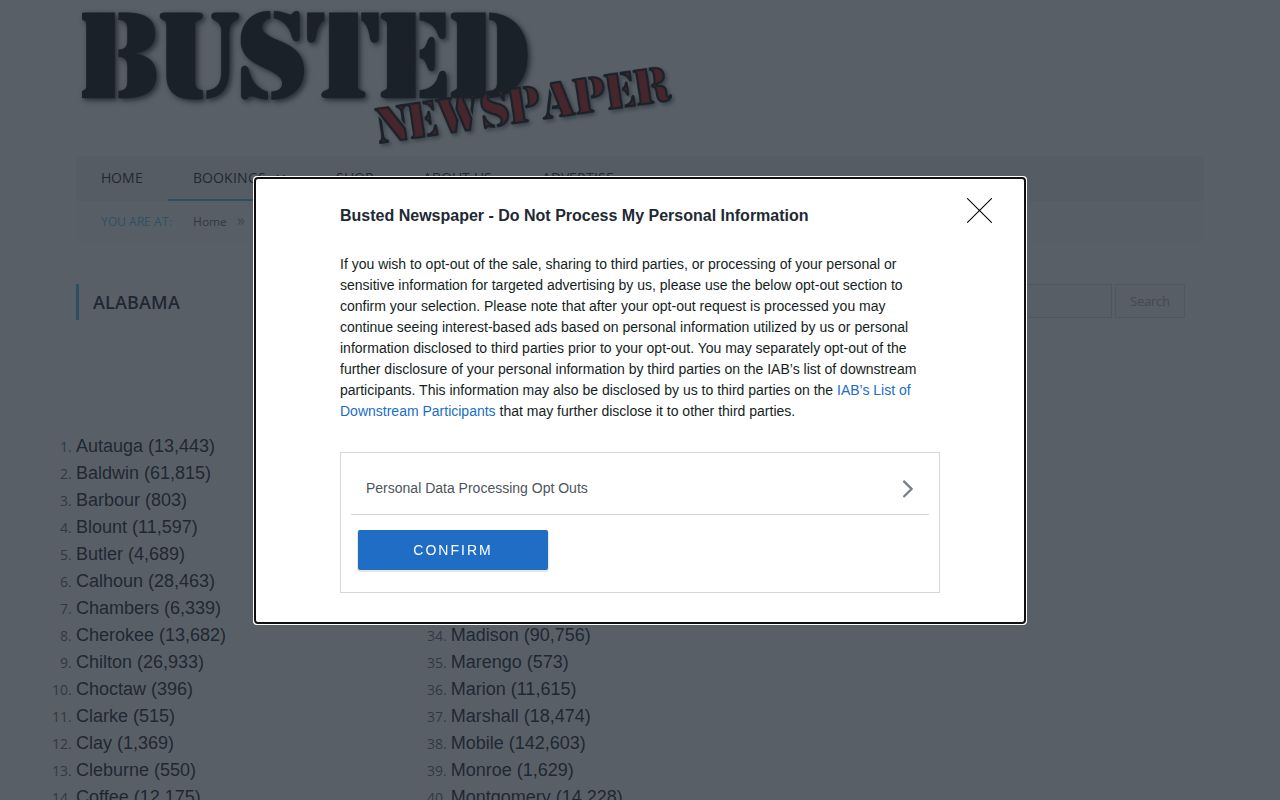
This state index page is a third-party view. It can omit counties or keep stale entries, so check the county source before relying on any item.
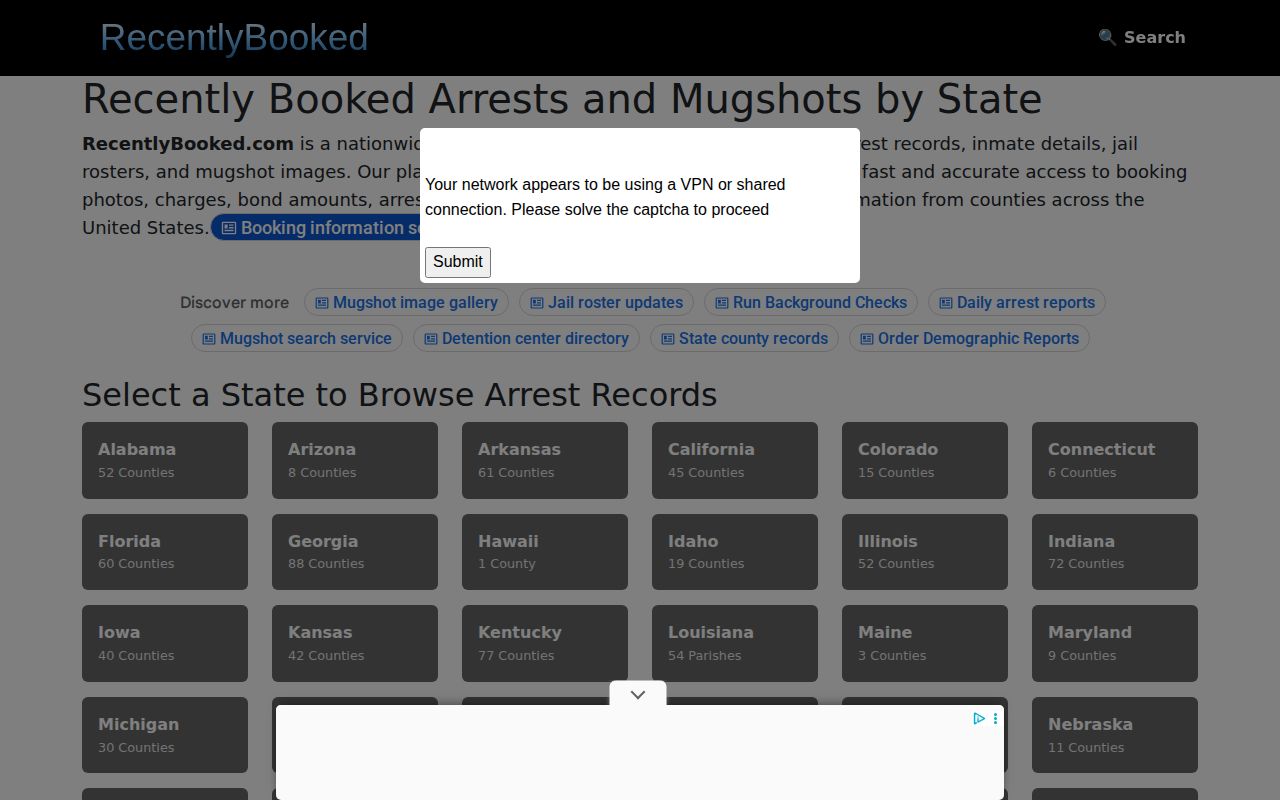
The image shows a selector and an access barrier. It is not a statewide custody system or a complete county list.
Note: A private publisher's copied entry may remain online after a government roster changes or a court later updates the case.
Alabama Warrant and Wanted Lists
Alabama tracks wanted people through several separate systems rather than one statewide warrant table. The ALEA Community Information Center handles public fugitive searches. Absconders from supervision get their own alerts through the Bureau of Pardons and Paroles. ADOC posts escape information, and the U.S. Marshals Service profiled fugitives list operates at the federal level. Scope, updates, and safety instructions differ from page to page.
Keep in mind what these lists are not. A fugitive notice is not a new arrest. It is not a full county warrant search either. The person may have escaped, walked away from supervision, or be wanted in a single case, and a local bench or arrest warrant may never surface on any statewide list. To resolve a possible warrant, the safe move is calling the issuing court, the sheriff, or an attorney. Never approach someone on a list.
Each screenshot shows a distinct official layer. ALEA's public search interface is a lookup tool only. The ADOC escape page tells the public to dial 911 or local police for an immediate threat or known location. The Bureau's notice concerns supervision, not a jail booking.
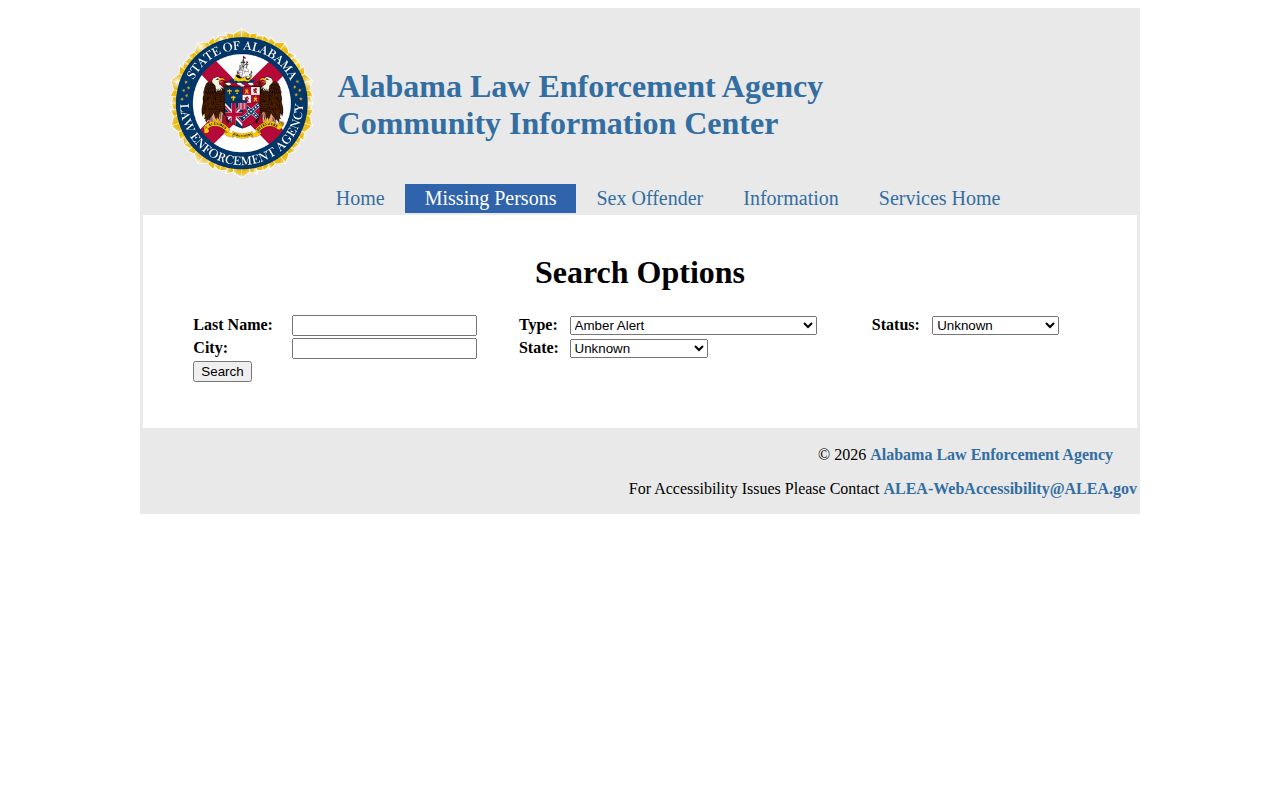
The search fields can help you tell an agency lead apart from a county jail booking. Still, check any name match with the agency named in the notice before assuming it is the right person.
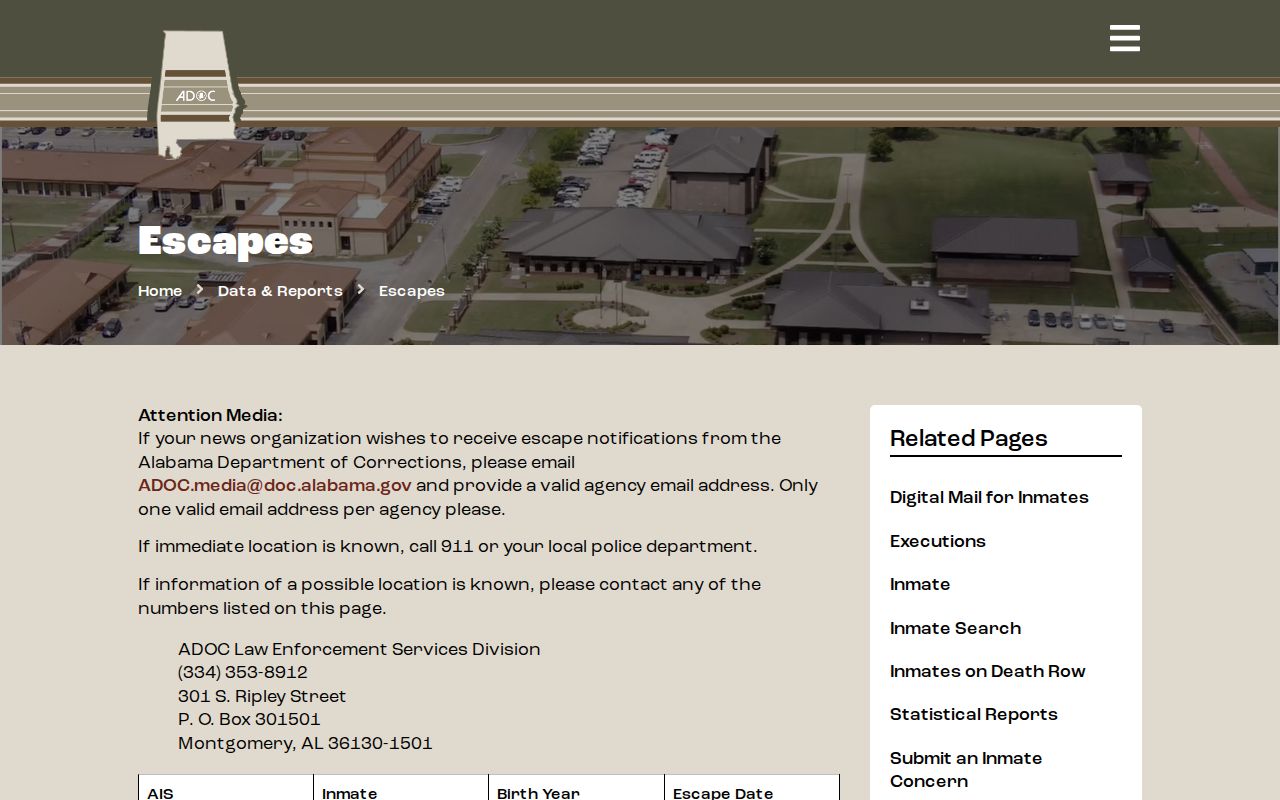
Safety guidance and an agency tip route appear on the state page itself. Pass a possible location to that agency rather than acting on it yourself.
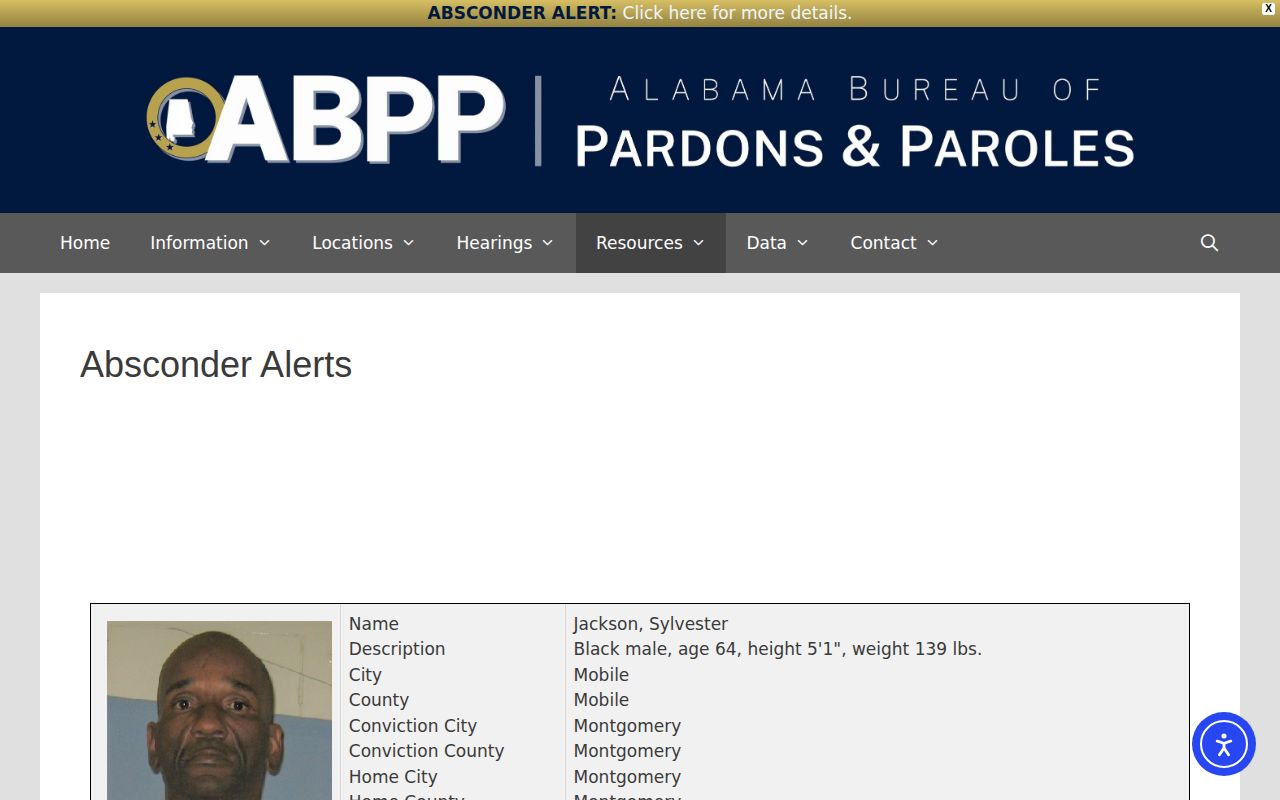
This parole notice covers supervision status, which is neither an open arrest warrant nor current county custody.
Note: An online wanted notice can be outdated or incomplete, so confirm a current warrant with the issuing authority before taking any step.
After an Alabama Arrest
Booking is only the start of an Alabama case. What happens next lives in the court record, not the jail roster. The Alabama Just One Look portal sells on-demand access to one case at a time. Pull a docket there and you may find hearings, bond action, pleas, dismissals, trials, or other outcomes. A booking charge on its own tells you none of that. Some matters stay closed to public view. Juvenile cases, expunged records, sealed files, and confidential or restricted matters can all limit what the portal returns.
The screenshot links straight to the state court portal for case context. It adds the court side of the story. Still, it is no stand-in for the original arrest report or booking sheet.
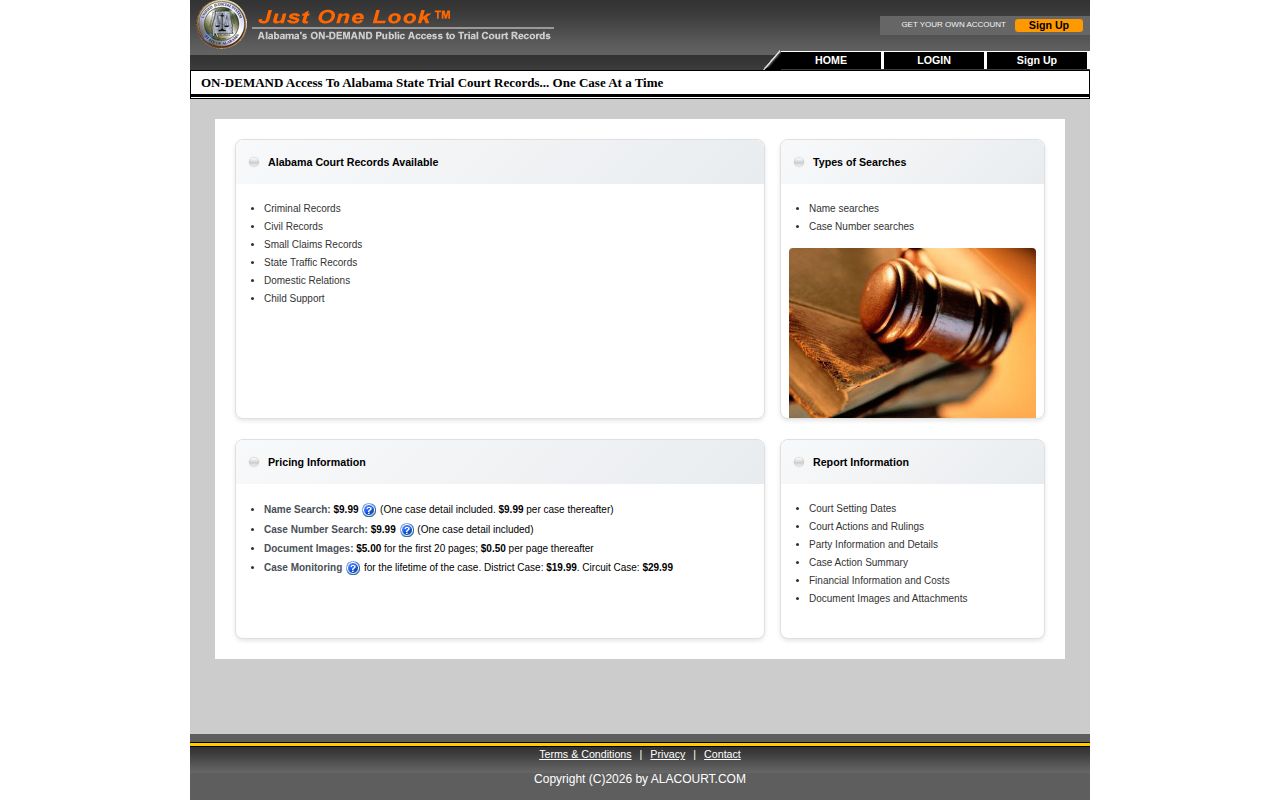
Match the case number and personal details before trusting a docket. Two people can share a near-identical name.
A state prison sentence moves the search to the ADOC locator. That replaces a county jail page. Federal custody works through a separate Bureau of Prisons locator. It carries no county arrest feed or county-style booking photos. Immigration detention relies on its own ICE locator. A transfer shifts which custodian can confirm present custody. The original county record still stands.
The federal image links to the BOP locator, which covers federal prison custody alone. It cannot tell you whether someone was booked into an Alabama county jail today.
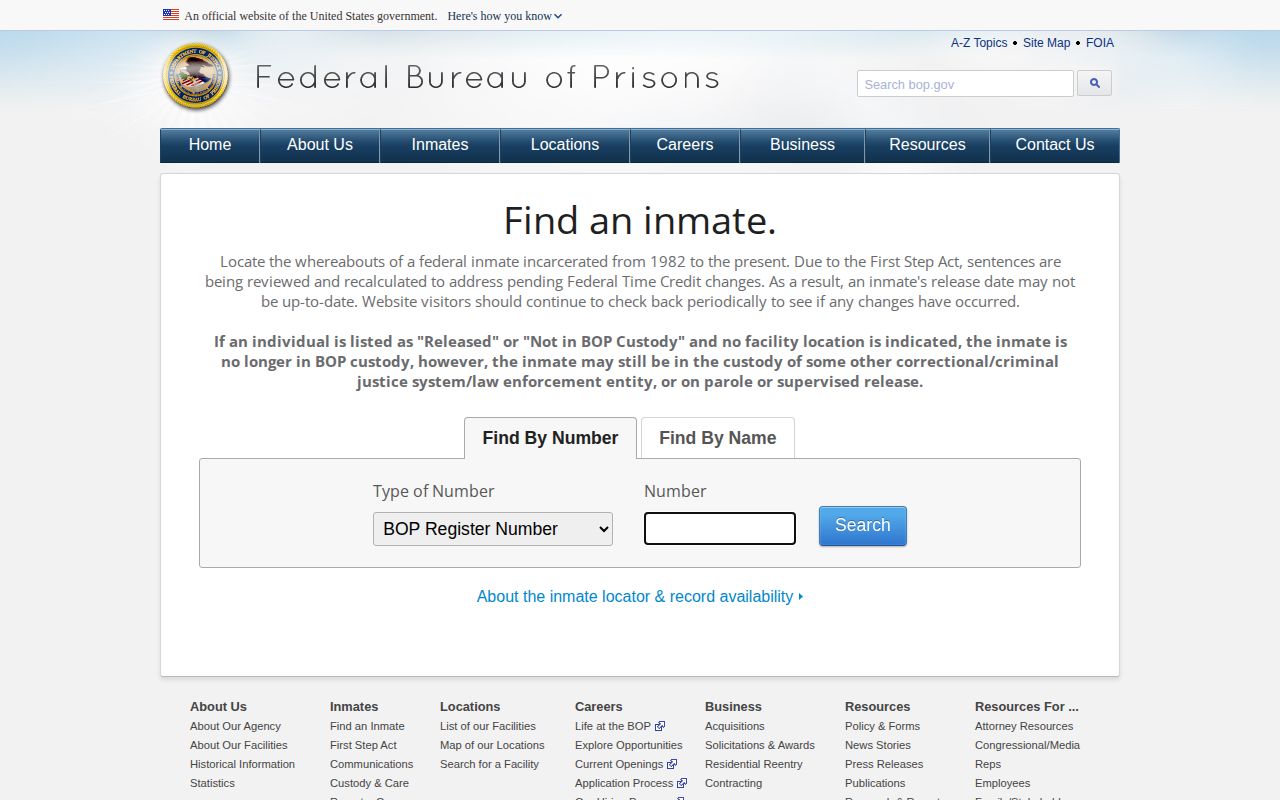
Note: Release from county custody, transfer to another agency, and a court sentence are separate events and should not be treated as one status.
Older Alabama Arrest Records
A roster vanishing from a county site does not mean the record was destroyed. Alabama sets no single retention period. Jail rosters, booking photos, arrest ledgers, dispatch recordings, and investigative files can each differ. Ask the record custodian about the record series and the approved Records Disposition Authority (RDA). Also ask about the date range held. Question whether anything was transferred or destroyed under that schedule. Court files run on court schedules, which may not match a sheriff's.
The Alabama Department of Archives and History incarceration collection holds historical corrections material, not current county booking photos. The image shows that archive's collection interface. For a recent arrest, start with the sheriff, the jail, an ALEA troop or post, the court clerk, or ADOC. Turn to a historical archive only after the original custodian confirms the record moved. It also suits a search targeting older corrections material.
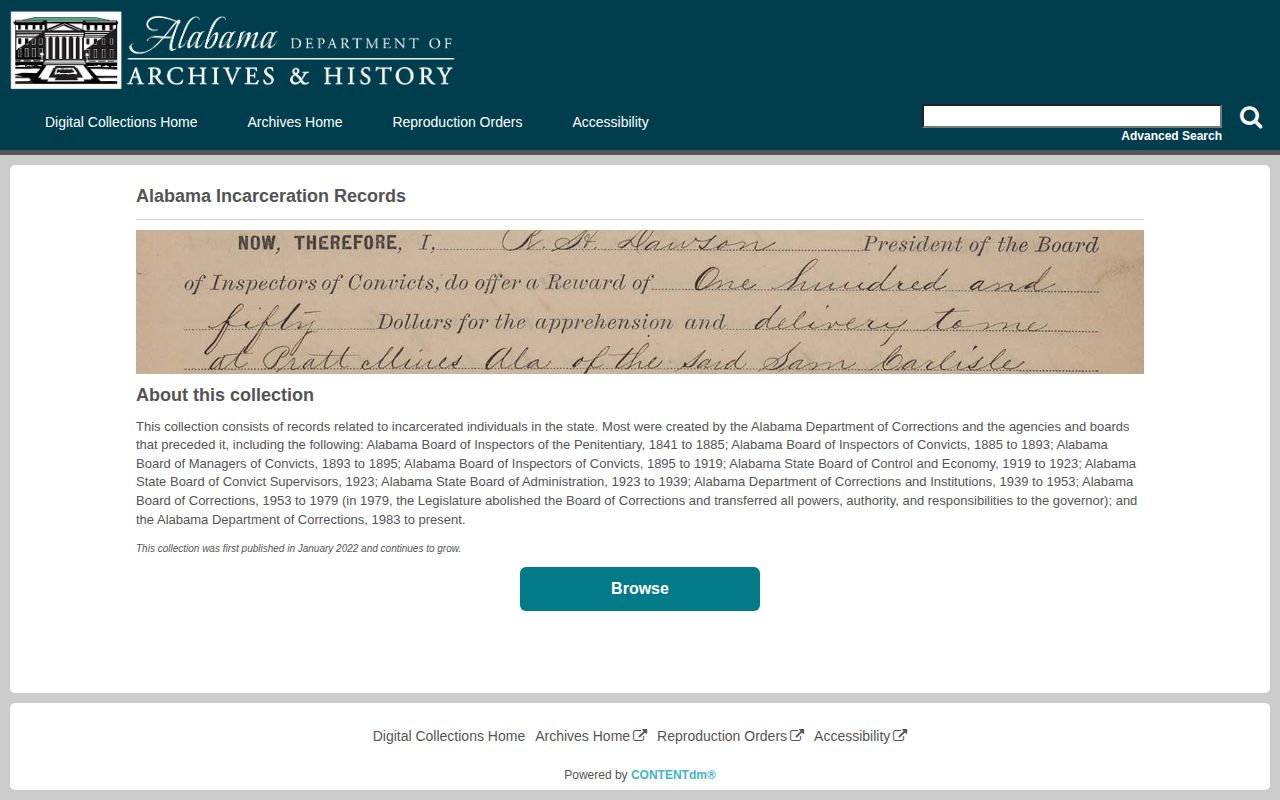
For court records, ask the clerk which schedule applies. A permanent case file does not guarantee a booking photo is kept forever.
Old online copies can outlive an official roster entry. A court order may correct the official record. A search result, private copy, or newspaper archive stays visible until that publisher handles a correction request. The legal path for a sealed or expunged case turns on its disposition and history. Rely on the current statute and forms rather than treating one online article as a universal rule.
Browse Alabama County Records
Every county page anchors the local coverage: sheriff, jail, city police, and the booking systems each opens to the public. Pick the county where the arrest happened first. That choice matters. A municipal department may have made the arrest, or a county deputy did, and the booking record lands accordingly. News reports name counties loosely. The town in a headline may not be the agency that holds the record. The County Directory maps every county site and its seat, so a records request goes to the right jurisdiction the first time.
Alabama counties vary widely in what they publish. Some run modern booking portals. Others post little beyond a weekly roster. One person can surface in a booking view today, a court file next month, and an ADOC or federal locator after transfer or sentencing. Chasing that trail takes patience. Match dates, agency names, booking numbers, and case numbers side by side. When something does not line up, ask the record holder to explain the gap instead of guessing.